Blur Store - The Best Gadget Store

Online shopping from the earth's biggest selection of gadget and just about anything else.

Enjoy your Watches

teks

teks

Casio G-Shock MTG-900 Review


The last time I had a new digital watch, digital watches were themselves a new idea. I can't remember what brand it was but I do recall that it had a green LED display and the batteries didn't last very long. You had to push a button to read the thing and it couldn't do much more than display the time but it was pretty neat for its day. Digital watches have advanced just a bit since then. The G-Shock being reviewed here is, without a doubt, the most sophisticated watch I own and Casio has even more advanced models available.

The Casio G-Shock line has earned an amazing reputation for durability over the last twenty-five years or so. The stories of abuse that these watches can take are really remarkable (see this thread at Watchuseek.com. According to the Wikipedia, the G-Shock was originally designed to be at least capable of surviving a 10 meter fall, 10bar water immersion and have a ten year battery life. The basic premise is that the watch employs a series of shock absorbers within the case that keep impacts from damaging the movement (called a module in Casio-speak). In addition to the ability to resist shocks, the case is also sealed against water and dust. As good as those original specs were, the current line goes even further when it comes to ruggedness. If you are tough on your watches, get a G-Shock-plain and simple.

The MTG-900 being reviewed her is a truly amazing piece of equipment. It has the usual G-Shock impact/shock protection and is water resistant to a depth of 200 meters, which should be deep enough for anyone. But, in addition to its toughness, this model has a two features that really make it special. First off, the watch is solar charged. The user need only wear the MTG-900 and its batteries will be kept alive through exposure to light. Like Citizen's Eco Drive line, the batteries in the MTG-900 should never need to be changed. As if that wasn't a nice enough plum though, this G-Shock goes it one better-it has atomic clock accuracy. No, there is no radioactive isotope decaying in the case. Instead, the MTG-900 has a tiny radio receiver inside it that picks up signals from the U.S. Atomic clock in Colorado and resets itself to atomic time automatically four times a day (it can also be reset to the atomic clock's signal at any time by pressing a button should you really be concerned about accuracy). As a consequence of owning a watch like this, I can now honestly say that I really know what time it is for the first time in my life.

Externally, the MTG-900 measures 44mm in width, 50mm lug to lug, and 15mm in thickness. The bracelet is integral to the case and tapers from 22mm to 17mm in thickness. The crystal is made of mineral glass and is recessed below a chrome plated bezel. The stainless steel bracelet of this G-Shock is unusual and very well done. It is not a solid link design but actually looks and wears like one albeit with a lighter weight which actually makes it very comfortable. There are cut-outs on the inside of each link to make adjusting the bracelet's size by removing links very easy and I do wish that other manufacturers would adopt a design like this. The clasp appears to be very strong and well-designed. Like most G-Shocks, the actual watch case is made of impact resistant plastic which on this model is colored to match the stainless steel color of the bracelet.

Timekeeping, as you can imagine with a watch like this, is flawless. For the heck of it, I opened up the time.gov page and compared it with the time on the G-Shock-spot on. The default display gives you the day, date (whose calendar is pre-programmed until the year 2039), month, hours, minutes, seconds, battery charge status and atomic time synchronization status. In addition, to the main screen (for lack of a better way to describe it) the MTG-900's other controls support 29 time zones (set by city location), 4 daily alarms and a snooze alarm, a time recorder that can remember 30 different time records, a stopwatch and an hourly time signal. If for some reason you keep this watch in the dark for extended periods, the battery will last for eleven months without light once fully charged (The watch goes into a power save mode which appears to shut off the display. Pressing a control will wake it up). Lastly, the watch face has a backlight that can operate in one of two ways. It can be manually activated by pressing the large "G" button below what would be the 6 o'clock position on the watch case. Additionally, the watch has a sort of smart light sensor built into it that will activate the backlight in low light conditions if the wearer quickly pivots the watch towards him/herself. Basically, flick your wrist and the light will turn on for a few seconds.

The MTG-900 is one of the most distinctive looking watches I have ever seen. It truly looks like nothing else out there while still managing to look very good, albeit it a high tech way. (One friend commented that it looked vaguely Klingon in style. I wouldn't disagree with that. The styling is both tough and aggressive). I would not recommend wearing a watch like this under a dress shirt (it is thick enough that the cuff button might not close) but, other than that situation, this G-Shock has no downside. It really does it all very well.

Steinhart/Debaufre Ocean One Review


The subject of this review, the Ocean One, is the first Swiss made automatic diver I have owned. (The previously reviewed Sandoz was only water resistant to 100 meters and thus was not fully a diver�s watch.) The watch came to me by virtue of a big sale that the folks at Steinhart are holding. The reason for the sale is related to that second name in the review title-Debaufre. It seems that another watchmaker(Steinhausen-whose watches are, to my knowledge, powered by Chinese made movements and look nothing like Steinhart�s) apparently felt that the names of the two companies were too close for trademark comfort, so to speak. Rather than spend lots of time and money defending themselves against a threatened lawsuit (and suits of this nature can drag on for years) Steinhart chose to change the name of their company. The name they went with (after making sure there would be no similar trade name issues) is Debaufre. Peter Debaufre was a watchmaker in the late seventeenth and early eighteenth centuries who developed a new type of escapement mechanism and was the first watchmaker to set moving parts into jeweled pivots to cut friction and improve durability. The Steinhart folks feel that this is a fitting name that honors a largely ignored detail of watch making past. It�s a gutsy move on their part and isn�t without risk, the good will and P.R. that they have built up so far is now on the line. I personally wish them the best of luck as I have been a big fan of their watches. Anyway, with the change, the newly named company had an inventory of watches on hand that still had the old name and now needed to be to be sold off. Thus the aforementioned sale, which I think is still going on at the time of this writing. I won�t say what I paid for this one but the price was substantially lower than what it was a few months ago, and that original price was pretty good then.

On to the watch itself. The Ocean One is a big stainless steel watch, stylistically modeled on the Rolex Submariner but larger all around. The watch measures 42mm in width (46mm including the crown), 51mm lug to lug, 22mm band lug width and 14mm thick. The crystal is sapphire (best to ward off scratches) and includes a cyclops magnifier over the date window (the first I have owned that actually provides useful magnification). Internally, the Ocean One is powered by ETA�s 2824-2 25 jewel automatic movement, a proven workhorse known for its durability and accuracy. The lume on the hands and face is white superluminova, the best type short of tritium tubes. In my observation it remained visible for a few hours in darkness, more than adequate for most users. As for water resistance, the Ocean One is rated at 300 meters, which is more than high enough for just about anyone. 300 meters is seriously deep. The bezel rotates in a counter-clockwise direction only, with a nice firm action and has an embedded luminous marker. (The bezel on a diver�s watch should never move in a clockwise direction. If knocked out of position underwater it could accidentally extend a dive time past the safe limit of available air in the tank). The watch uses a heavy, solid link bracelet which thankfully included solid end links. (I am not a big fan of hollow end links, they tend to rattle and bend). The clasp is a flip lock design, that while not the best one of its type that I have seen (the adjustment range could be better), does get the job done well enough. (I have heard from the folks at Steinhart/Debaufre that the new models have an improved bracelet). Lastly, the watch can be hacked and hand wound and includes a nice sized, signed crown.

The Ocean One wears very comfortably despite its large size. In my opinion, anyone who appreciates nice watches would find a lot to like here . If, like me, you admire the looks of a Rolex diver but don�t have the coin for one (my kids and my $ go to private school I�m afraid) but don�t want to buy an obvious Rolex copy, the Ocean One is an excellent choice. It looks great, is quite accurate and should have no trouble surviving extended exposure to water. Best of all, it won�t break the bank. Grab one while you can.

Vostok Komandirskie 3AKA3 Review


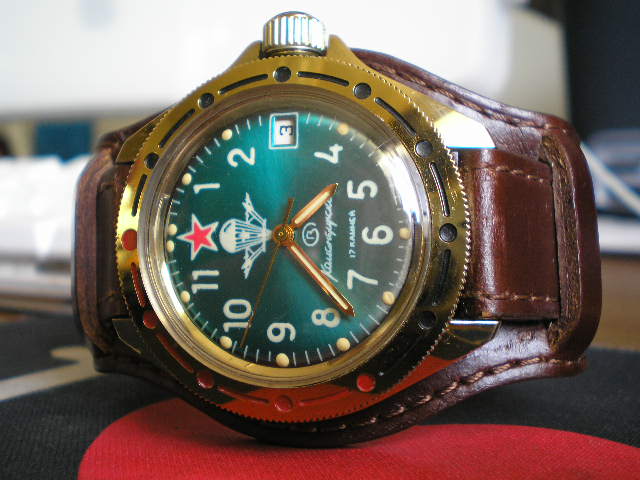
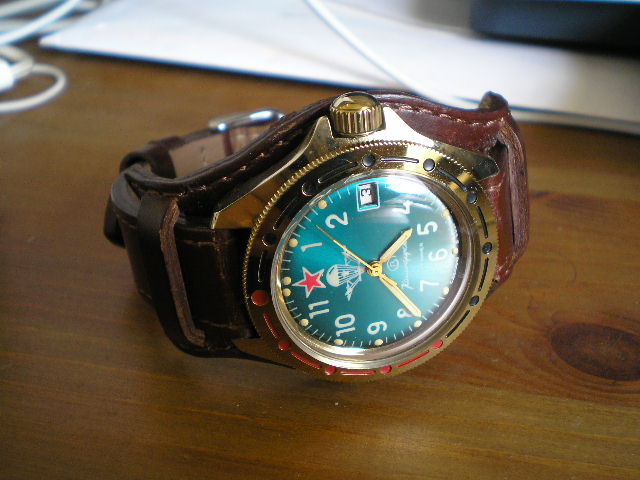
On a Nilsen bund strap


This review is, in many respects, similar to the Vostok Komandirskie review that I did a few years back. However, there have been so many new old stock (NOS) examples of this model turning up on the global tag sale that I thought it would be a good idea to not only acquire an example but to see just what you get with one of these older models.

.

The main feature about this particular Vostok that interested me is the lettering on the dial to the left of the 6 o'clock position. There the notation 3AKA3 appears. What this means is that this example was specifically ordered by the Soviet ministry of defense to be issued to a soldier. (It never was issued, however, and I acquired it new in the box with the tag still on and the paperwork included.) Models with the 3AKA3 designation are rarer than ordinary Vostoks which are simply labeled as being made in CCCP or, these days, Russia.

.

This example's case measures 40mm in width (43 mm with the crown), 45 mm lug to lug, 11 mm in thickness and has an 18 mm band lug width. Unlike the previously reviewed model, this one has a gold-tone case (actually plated with titanium nitride). The movement is a Vostok workhorse, the 17 jewel 2414A that has a reputation for being very rugged. The watch uses a typical thick Vostok acrylic crystal and has the company's signature two-piece back. So far, it has been running quite well, gaining about 20 seconds a day. (That could probably be improved on with regulation, to say nothing about a cleaning and oiling given this model's age, but I can live with it.)

.

In comparison to the newer Komandirskie I reviewed earlier, this older model is very similar. They both use the same movement and share the same overall design. The only significant differences are that the older Vostok has a larger crown (that resembles the crown used by the Amphibia series of Vostoks), and the shape of the bezel is somewhat different. The lume on the 3AKA3 seems pretty much inactive, glowing for only a few minutes after exposure to light, but even new Vostoks have lousy lume too. One detail about the old Vostok does merit mention though. The overall quality of the watchcase and it�s plating in particular, seems superior to that of the newer models. It just looks better finished to my eye. Other than that though, these watches clearly emerged from the same factory.

.

In summary, I'm glad I finally got my hands on one of these. It is both a nice field watch and a historically interesting piece. If you are thinking about picking up one, and you have dabbled in Russian watches before, be forewarned-the time when these 3AKA3s could be had for $20 is over. Expect to see nice examples in the $60-$120 range these days, possibly even more. The market is finally catching up to even Russian watches I'm afraid, although there are still buys to be had.

Timex Maratac Compass AQC-Watch Review


On an aftermarket nylon Mil type band


On a 4-ring Rhino band.


Not the prettiest of movements but it is what it is. Movement is stamped TMX, 301, Philippines


On the Maratac strap


Face Detail


Crown & Compass controls


Fixed Lug Bars


Caseback Detail


When I sat down to write this review I realized that I was feeling a bit nostalgic. The last time I had a new Timex, they were still running those ads with the elephant. I remember mine pretty well. It was a stemwinder with a white face, black Arabic numerals and a black leather band on a chrome-plated case. It wasn't an expensive watch (what Timex ever really was) but it was my first new watch and I really loved it. I wore it from grade school through high school and it ran like a charm. Things have changed somewhat since those days at Timex but the one thing that's still the same is that you get a lot of watch for your money.
You might think that Timex needs no introduction as brands go. They've been around for a long time, after all, and they are available everywhere. That pretty much sums up how I felt about them until recently. What made me take more notice of them was a big article about the company in the August 2006 edition of IW magazine (whose archives are generously available on their website). What I learned is that Timex has been around since the 1850's, is headquartered in Connecticut and uses movements that are designed in Germany, built in France and cased in the Philippines. A very international entity, to say the least with a long and interesting history. Timex's German facility is what remains of the old Laco and Durowe watchmakers, which Timex (then called US Time) bought in the 1950s. In addition to the Timex brand, the Timex group also includes Guess, Nautica, Timberland, Ecko, FCUK, Reebok, Liz Clairborne and Versace brands. The article in question stated that it is estimated that Timex is the fifth or sixth largest watch manufacturer in the world. In an effort to enter the luxury market, Timex is now releasing a new high-end brand called the TX, which includes an attractive flyback chronograph among other models.

The Timex Maratac being reviewed here is an interesting model. Maratac, the maker of extremely tough watchbands, had Timex make this model for them to market to American military forces. The watch has a matt finished stainless steel case with a bi-directional bezel (that has an embedded luminous marker). The watchcase measures 43mm in width (including the crown), 47mm lug to lug, 13mm in thickness and has a 20mm band lug width. The crystal is made of mineral glass and water resistance is rated at 100 meters. The watch has fixed spring bars (non removable) like many watches meant for military use and ships (not surprisingly) with a nylon Maratac band. There are two lume systems on this watch. The hour and minute hand are coated with what appears to be superluminova that lasts for a few hours after exposure to light. Also included is Timex's Indiglo lume, which is essentially a very fancy electric backlight for the whole watch face. Pressing in the crown activates it and it illuminates the dial for a few seconds before automatically shutting off. It should be noted that this watch is really a modified version of the Timex Expedition model. The differences are the fixed lug bars, a sterile watch face (easier to read without any words written on it) and a straight instead of tapered lug shape. That and the included Maratac band and the Maratac name on the case back.

In terms of performance, The Maratac Timex is typical of many quartz watches in most respects. Accuracy is excellent as is to be expected and the watch includes a date function. This model does have one very unusual feature, however. It also includes an electronic compass. A long fourth hand on the face is, in fact, a compass needle that is activated by pressing either of the buttons along side the crown (They look like chrono pushers but that's not what those buttons are for. The reason for having two of them is to allow you to set a local declination angle instead of just letting the needle point to magnetic north. One button advances the needle, the other retards it). The compass has to be calibrated before being first used, a process that takes less than a minute. Once done, the watch will give a compass reading when activated on a flat surface. It isn't hard to see why Maratac thought this watch would be useful to soldiers.

The Timex Maratac seems as nicely made as any mid-level watch I have encountered. Nothing about it says cheap or disposable. If the overall quality I see on this model is indicative of what the TX line will be like then Timex should do well with them. This watch is, in the final analysis, a nice solid field watch and, if the idea of having a compass with you at all times is appealing, this one's for you. It would make an excellent daily wearer too.

P.S.-I picked this one up here.

Poljot Buran Chronograph Review


On one of Nilsen's Bund straps


The history of early aviation would not be complete without mentioning the aviator's chronograph. Early aircraft did not include much in the way of instrumentation but in order to properly navigate, however, accurate timekeeping was essential. One solution that was hit upon was the use of a chronograph watch. Many well known companies produced watches for this purpose (Breitling probably being the most famous example). The Buran Chronograph falls into this category of watches as well.
The story of how this particular design came to be produced by Russia is historically interesting. Originally the precursor to this watch was manufactured in Germany (I believe by Tutima using a Urofa chronograph movement-see: Reissue Issues). When WWII ended, the factory that produced this type of chronograph fell into Soviet hands. The Russians liked what they found and transported the assembly line back to Moscow. Production then began on a Russian version of the German chronograph which they called the Kirova (presumably named after Sergei Kirov). The Buran Chronograph being reviewed here is one of two re-issues of that German designed watch. (A more historically correct version, appropriately called the Kirova was produced along with the Buran (whose name means "Storm" I believe in Russian and may possibly be named after the Buran space shuttle). Irrespective of the name, however, the appearance of the models with their coin-edge bezels is unmistakably based on the old Tutima design. The re-issues do not use the Urofa movement however.

The Buran Chronograph has a matt finished stainless steel case that measures 40mm in width (not including the crown), 13mm in thickness, 52mm lug to lug, and has a 20mm band lug width. The crystal is made of mineral glass. (It should be noted that there is a smaller, 37mm version of this watch. If you are considering purchasing one of these, ensure that you get the right sized model.) The Buran's crown is particularly prominent and has the Poljot logo engraved on it. Internally, this re-issue is powered by a Poljot 3133 23 jewel hand wound movement. (The 3133 is based on the Swiss Valjoux 7734. The Russians bought this movement and its assembly line from the Swiss in the mid-seventies. Additionally, Poljot appears to have sold the tooling for the 3133 to another Russian company called Maktime . It is still being made and is widely used in Russian chronographs to this day.) The action of my example is very smooth and the 3133 has a long power reserve, generally in excess of 50 hours. The bezel on this Buran rotates freely in both directions (I have heard that on some versions of this watch the bezel is fixed) and the hands and numerals on the watch face appear to use superluminova lume which works quite well. In a pleasant surprise for a Russian watch, the Buran arrived on a leather band of reasonably good quality with a signed clasp. In terms of accuracy, my example seems to gain about 20 seconds a day. I can live with that but a jeweler might be able to improve the accuracy with regulation.

At one time, Russian watches were ridiculously affordable for what they delivered. That state of affairs has, sadly, ended. While it is still possible to find a good buy on the bay and elsewhere, there is no seriously denying that Russian watches, the chronographs in particular, have become very pricey. While a Russian chronograph is still considerably more affordable than its Swiss counterparts, with prices commonly exceeding $400.00, they are no longer an impulse buy. As much as I miss seeing $100.00 Sturmanskies and the like, it really isn�t all that surprising that this market would eventually even out. With the ruble gaining strength on Russia�s oil revenues, there was really no other outcome. The example you see here was a fluke in my opinion. I recently acquired it, new in the box, for well under $180.00.

Like so many other Russian timepieces, the Buran Chronograph has the type of rich and interesting history that makes watch collecting so enjoyable to me. It is one of those pieces whose old-fashioned looks immediately remind me of its origins. In some ways, I find the process of learning about the history of a watch to be as enjoyable as actually acquiring a new piece for my collection. When it comes to having an interesting past, Russian watches rarely disappoint.

P.S.-If you are really interested in Russian watches, be sure to visit Mark Gordon's excellent site. His collection is really remarkable

Picked up this NOS Vostok


Not really a full review this time. This one is functionally the same as the earlier reviewed Komandirskie. Same 2414A handwound 17 jewel movement. Basic design is very similar as well. This one is gold colored though. I don't know if it is brass or some other sort of plating that is used but the effect is visually striking. This particluar one is NOS (new old stock). Its dial has CCCP written on it but the included papers indicate a 1992 manufacture date. Probably was assembled from old, pre-collapse Soviet stock. Arrived in virtually mint condition. Not bad for $21.50. I think the bund strap works well with it.

Steinhart Militare UT 6498 Review


UPDATE-Steinhart/Debaufre released a small crown version of this model for a while. Thanks to the generosity of a fellow member of the Poor Man's Watch Forum, I have that crown, free of charge :) . Here it is fitted to the Militare. I think it looks terrific.


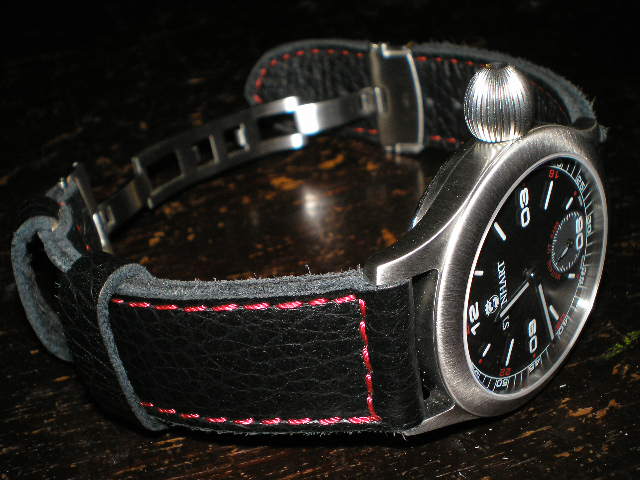
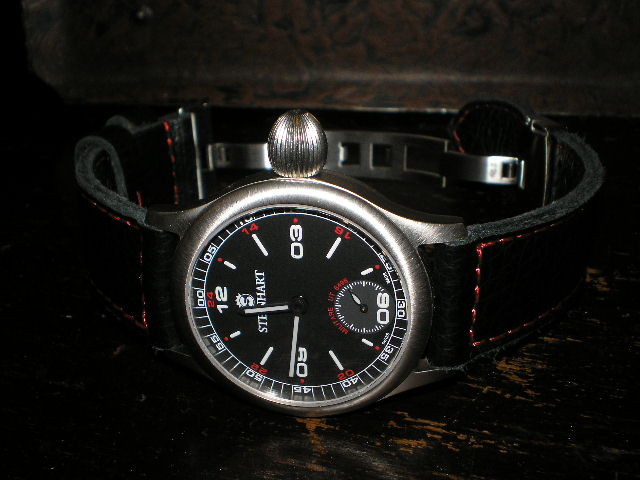
On a Nilsen aviator for a change of pace. This watch would work well with many military style watchbands.


Update: If you are wondering who Steinhart is or are having a hard time tracking the company down, point your browser to Debaufre . After another company threatened to sure Steinhart because they thought that their name and the Steinhart name were too close, Steinhart decided to change their name to Debaufre (an early watch maker who pioneered several innovations in design). Nothing else has changed (aside from models being offered), the service and value are still excellent.

I am starting to associate the arrival of a new Steinhart with good developments in my life. My last one, the World Traveler, arrived a few days before my birthday. The subject of this review, the Militare, has come to me just days before the start of a new job (more $$, better benefits, all that stuff). I view its arrival as a harbinger of good things to come.

I am a sucker for watches with subdials. There is something about that style that says old world class to me. Until now though, I have not owned a Swiss watch with this feature. My newly acquired Steinhart Militare UT 6498 perfectly fills that void. As its name implies, the Militare is designed as an ode to early military watches. The large onion crown, in particular, recalls military watch styles from the time of both of the world wars. (See examples here)
The Militare is a large and attractive watch that measures 42mm in width (50mm with the crown), 50 mm lug to lug, 10 mm in thickness and uses a 22mm lug band width. The watchcase is made of stainless steel and is equipped with a display back that gives a wonderful view of the movement. The crystal on the Militare is made from sapphire, the best material to make a watch crystal from in terms of scratch resistance. The hands and indices on the face are coated with superluminova (a high quality glow-in-the-dark paint) that after 30 seconds of continuous exposure to a light bulb remained visible for slightly more than six hours in darkness. The indices on the face incidentally have both a 12 and 24 hour scale if that is important to you. Water resistance is rated at 5 atm, which should be fine provided you don�t go diving with it. The watch comes with a comfortable, well-made, black leather band that has a signed deployment clasp.

Internally, the Militare is powered by a Unitas 6498 17 jewel hand wound movement. The Unitas is an old and very well thought of Swiss watch movement. It was originally developed by the Swiss firm of Auguste Reymonde in the 1950�s as a pocket watch movement. Today, it is manufactured by the Swiss movement maker ETA. (For a terrific history of the Unitas and Auguste Reymonde, see: this site) The movement�s large size and robust performance has made it a popular choice for many watch manufacturers these days. The example in the Militare is decorated with an engine turned finish and blued screws and makes for a nice view through the display back. The 6498 does not have a hacking feature if that matters to you. Accuracy of my example appears to be in the neighborhood of ten seconds daily, which is just fine.

To say that I like this watch would be an understatement. It has a unique look to it that pays homage to vintage military timepieces but still manages to look original. It appears to be very well assembled and contains a movement that has a rich heritage. Price wise, this one falls in the middle of Steinhart�s line. Currently listed at $695.00, the Militare is a fine watch and a good buy in my opinion. (Unitas equipped watches run the gamut from a low of $200 to well up into the thousands) I fully expect to get many years of enjoyment from this watch and its apparent high quality speaks very well of Steinhart as a company.

(As an aside, the October 2006 edition of iW (International Watch) magazine has a very nice article about Steinhart. If you want more information about the brand, this would be a good read. Additionally, Steinhart is acquiring a reputation for truly world class customer service. E-mails are returned promptly and any issues or questions are dealt with in a straightforward way. These folks really want their customers to be happy and they provide a level of service that I have frankly never encountered before. If the personal touch matters to you, you�ll love this company).