Fine old things
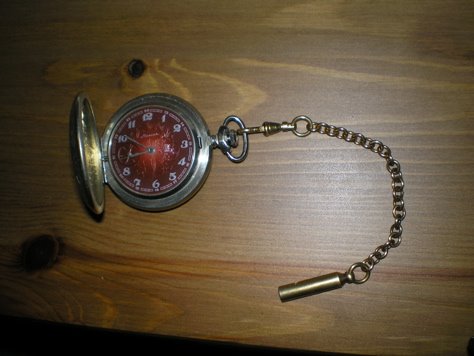
On an old fashioned watch fob :)
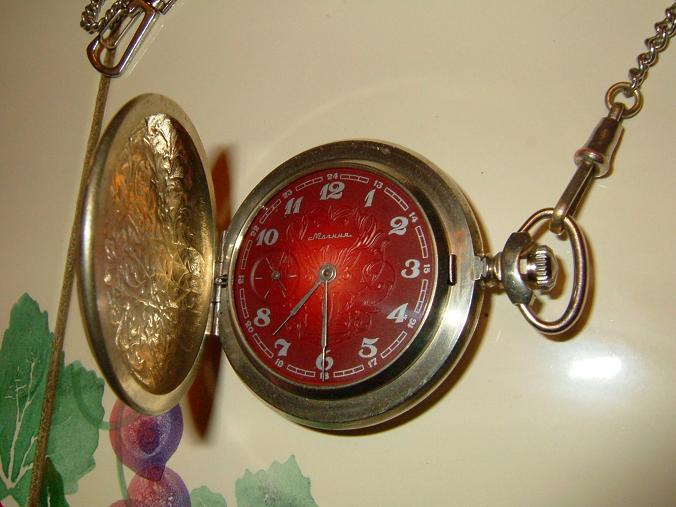 Yet another Molnija. This one is new old stock from the late eighties. Below you can see the movement which appears more nicely made than the current version.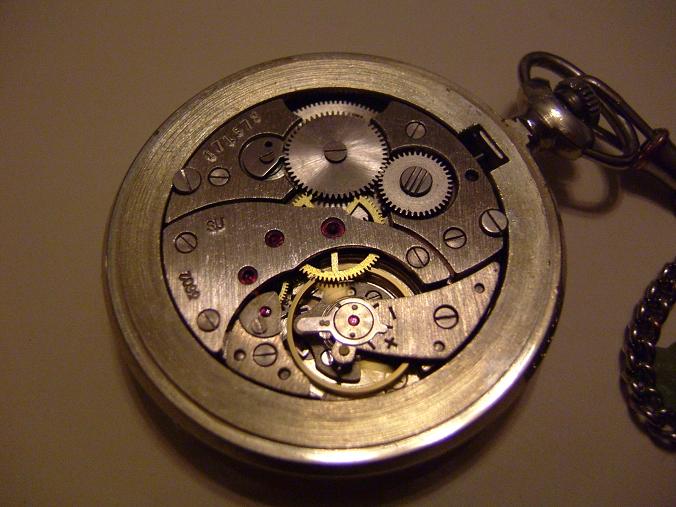
 The Braille model on its belt chain
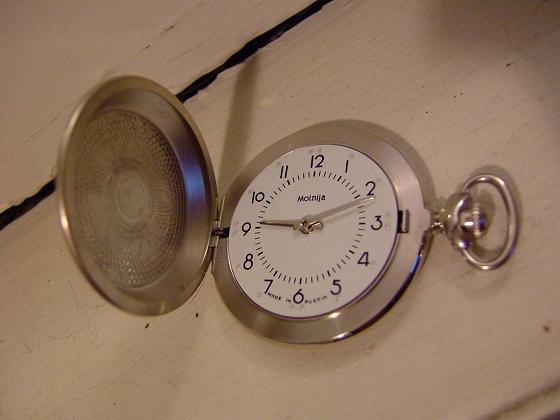 Braille Model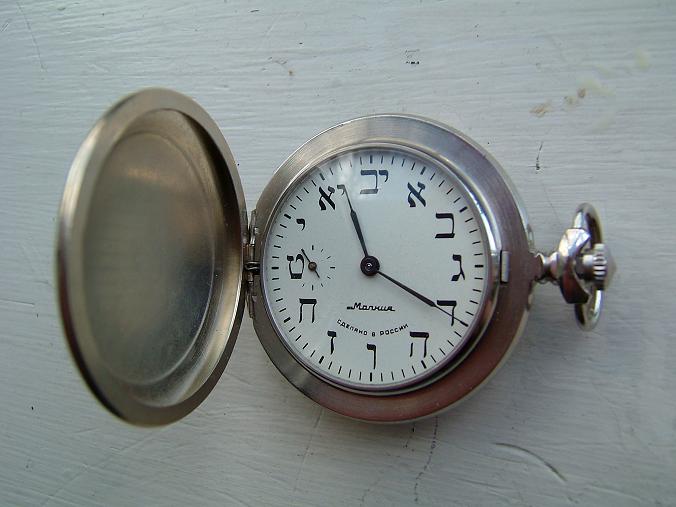

I wasn't planning to write this review. It isn't that I don't like the Molnija pocket watch, quite the contrary actually, I like it a lot. It is simply that I appreciate that pocket watches are just not that popular these days.
There was a time, not all that long ago really, when a pocket watch was considered an essential accessory for any gentleman. Wristwatches, by contrast, were considered somewhat dainty or effeminate when they were introduced and did not gain much market acceptance early on (for more on the emergence of wristwatches, see this article). This would, of course, change as we all know but there still remains a small market for pocket watches. What really prompted me to review the Molnija, however, was sort of a sense of historical irony that developed when I began to do some research into the history of Molnija and, in particular, its movement.
A little background first. The Molnija Clock and Watch Factory was founded in 1947 in the Russian city of Chelyabinsk. The name Molnija, I have read, means lightning. While the factory initially produced a combination of wristwatches, pocket watches, desk clocks and clocks for tanks and other military equipment, from the late 1950's to the present day their main products have been pocket watches. It is said that eighty percent of the manufacturing of these watches is done by hand and that the factory produces all of the parts involved entirely by itself, except for the jewels used in the mechanism. (It is not uncommon for watch manufacturers to subcontract to third parties a large portion of the parts that go into a watch these days) Molnija produces such an amazing variety of case styles and faces that I would find it hard to accept that someone could not find one they liked. The model being reviewed here is from their Religions collection.
Update-The top shots are new. The white faced model is a Braille Molnija. Notice the lack of the subdial and crystal to allow for a person to touch the hands of the watch. The watch hands, by the way, are reinforced to keep them from being deformed in normal use. Otherwise, it is very much like the other Molnija models. The other one with the red face is a new old stock (NOS) model from the late eighties that I found at the back of the counter at a local jewelery store. Odd thing is that I have been walking past this store for years and only just wandered in a few days ago. The owner had a nice assortment of mechanical watches including some Russian ones. Turns out the he was from Uzbekistan and brought the watches with him when he came to the U.S. One other thing. A good chain or fob is essential if you plan to carry a pocket watch. It will keep you from droping the watch when using it. After looking around for a while, I found an ebay seller, Paternosterny, who makes his own chains and fobs. His prices are very reasonable and the quality of his work appears exceptional. The top shot shows one of his whistle watch fobs.
Externally, the Molnija case measures forty-eight millimeters in diameter, not including the crown, and fourteen millimeters in thickness. The case appears to be built from chrome plated steel (I have encountered some claims that it is German silver. It could be true but I have no way of verifying it.) and has a spring-loaded cover over the crystal that is opened by pressing in the crown. The face of the watch has a subdial that measures seconds and both the back of the watch and the crystal are easilly removable. (The crystal is mounted in a chrome plated metal bezel that can be removed as a unit with a watch knife or similar tool. This is a useful feature to remove any dust that may have gotten on to the watch face.) The watch has no lume and is clearly not water resistant.
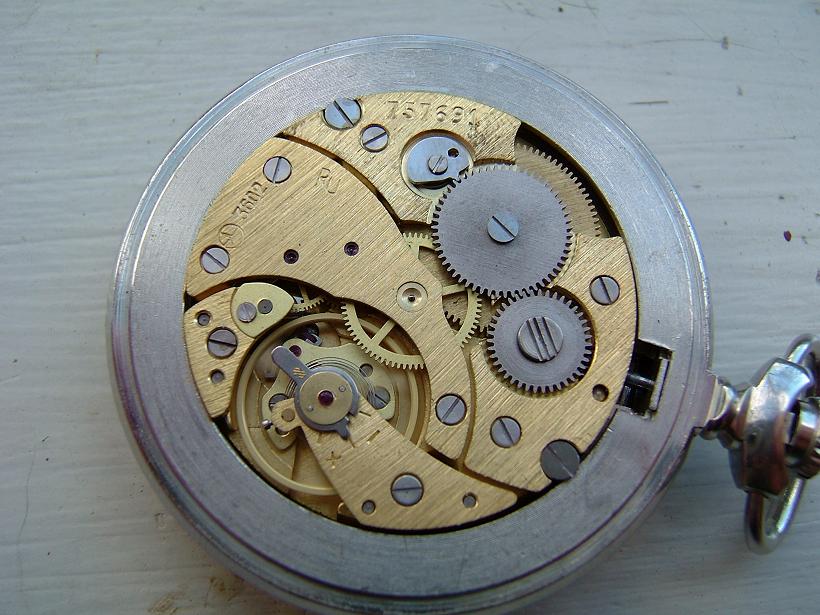
The Molnija is powered by a model 3602 movement, an 18 jewel hand-wound mechanical mechanism. Rated accuracy is nothing to write home about at -20 to +50 seconds a day although my example does considerably better coming in at approximately +20 seconds daily with good consistency. The movement does not hack for those of you who value that feature. What I personally found very interesting is that the 3602 movement is actually a copy of a Swiss Cortebert pocket watch movement that was originally made at least sixty years ago. While I am not sure exactly which of the old Cortebert movements the 3602 is based on, it bears strong visual resemblance to the model 592 and 620 Cortebert movements. Maybe its just me but find it interesting to consider that a twenty-first century Russian factory is still producing new mechanical pocket watches whose movement dates from the first half of the last century. While I appreciate that there are many currently produced wristwatch movements that have a long history as well (I occasionally wonder who is still producing the oldest designed movement out there-maybe the huge Zlatoust Diver watch that this one is in a pocket watch makes it even more of a curiosity in my mind. Every time I wind it up, set it, and clip its chain to my belt, it occurs to me that prior to World War I, everyone who had a watch did the same ritual every day. (Yeah I know, I'm a little odd) As an aside, a slightly modified version of this movement, the 3603, with better shock protection is used in a number of Poljot and Junkers (German) wristwatches.
The obvious question when it comes to a pocket watch these days is, of course, why bother? My answer is simply this...why not. It keeps time well enough, you won't see everyone else out there with one and it looks nice. To that you can add that, like many Russian watches, the price of admission is not high at all (see this ebay store, or here , there are many others too). Would I necessarilly carry my Molnija every day, probably not (not that it wouldn't work well in that role). But as for an occasional change of pace, and for those times when a wristwatch is a bad idea I think the Molnija is a terrific choice. (I play golf pretty regularly and, with the exception of Tag Heuer's newly released Tiger Woods golf watch which would set me back a fair amount, wearing a wristwatch is not a good idea. The vibrations from the swing would damage the watch and the weight on the wrist is annoying. I haven't thought about it much but there are probably other times when a wristwatch wouldn't work too. Maybe when operating machine tools and the like?) In the final analysis though, if you want to own a small piece of history and you like watches, (you probably wouldn't have read this far if you didn't) give a Molnija a try. They are inexpensive, nicely made and a decidedly different and old world way to measure the passage of time.